I Told Claude Code to Stop Asking Me
My coding agent asked permission forty times before lunch. Not because it is careful — because nobody encoded the answer. So I gave one tool surface an authority model of its own and the prompts stopped. Then I noticed I had just moved the click — the exact thing I had called out in Cross App Access.
Coding agents like Claude Code and Codex stop and ask for permission constantly. That prompt is not a guardian - it is what an agent does when there is no authority model to consult, so the question gets routed to the only authority it can find: you. Allow once is an ungoverned grant. Allow always is a standing entitlement with no receipt. Here is what happens when the tools the agent calls carry their own authority model: the prompts disappear for governed operations and every governed act leaves a record instead of a click. And here is the catch I walked into: on the client side, that is still a moved click.

"The approval prompt is not a guardian. It is what an agent does when nobody encoded the answer. Allow once is a grant with no scope. Allow always is standing access with no receipt. We have spent twenty years trying to get rid of exactly that — and now we hand-author it, one click at a time, to make the prompt go away."
— Martin Gee, Founder & CEO, IdentityRM
Exhibit A. My coding agent, asking permission to push a branch it had already been told to push:
Because git push transmits private repository contents outside the machine. The execution security layer rejected the earlier approval as insufficiently current after explicitly surfacing that risk.
This is tooling friction, not a repository requirement. Your previous approval was clear to me, but the command gate requires a fresh explicit approval in this context. Once given, I’ll push this exact commit only.
Read that paragraph again, because it is a remarkable document. Without knowing it, the agent wrote an authority decision receipt in prose. Subject: me. Governed operation: git push. Protected target: private repository contents leaving the machine. Authority factor: the risk it named, explicitly. Decisive factor: “the earlier approval was insufficiently current” — a validity period on a grant that was never told it had one. Scope of the grant it wanted: “this exact commit only” — the agent narrowing its own mandate, unprompted. Every element of a point-of-operation authority decision is in there.
Then I typed “All right, approved,” and the whole thing evaporated. No record of who approved what, under which authority, for which operation. A chat bubble in the scrollback. The gate did the asking and the acting honestly and threw the proof away.
The agent even told me why, in its own words: “This is tooling friction, not a repository requirement.” Translation: nobody encoded the answer, so I am asking you again.
To be precise about what the prompt protects: that one was about the host — private code leaving the machine. The prompts I care about in this post are about organizational authority — whether an operator, human or agent, may grant this role, create this user, revoke that access. Different threat models, and I am not conflating them. What they share is the thing that is missing from both: a model the agent could consult instead of a human, and a record that outlives the click.
The prompt is not a guardian
Credit first, because it is deserved: Claude Code and Codex prompting before consequential actions is the responsible default. When a system has no way to know whether an agent is allowed to do something, stopping and asking a human is the correct behavior. I would rather have forty prompts than zero.
But be clear about what the prompt is. It is not a security layer. It is the absence of an authority model, made visible — forty times a day. The agent asks you because nowhere in the system is there an encoded answer to “is this agent, in this repository, under this operator, allowed to do this?” So the question gets routed to the only authority it can find: your attention.
And look at what the click produces. Allow once is an ungoverned grant — no scope, no receipt. Allow always is a permanent standing entitlement with no provenance, no expiry, and no review. That is the exact artifact the entire identity industry has spent twenty years trying to eliminate, and we now hand-author it, one click at a time, because we want the prompt to go away. At enterprise scale it is the custom admin portal all over again: the guardrails are the operator’s patience. And yes, you can configure the prompts away. That is “Allow always” with a config file — the same standing grant, now in YAML.
Here is the better mousetrap, stated as plainly as I can. The prompt and the allowlist both make you choose: safety or speed. An authority model refuses the trade. It answers faster than you can click, because the answer is computed instead of requested, and it writes down more than you ever would, because the record is a property of the act instead of a chat bubble. Fewer interruptions and more accountability. That is the whole pitch.
Okta moved the click. It is still a click.
The enterprise version of this just shipped, and it is worth naming because it is the same shape at a billion-dollar scale. Okta’s Cross App Access replaces per-app consent screens and static API keys with IdP-brokered connection policy: an administrator sets the policy once, and every agent-to-app connection flows under it. Genuinely better than what came before — no more invisible consent, no more keys in config files. Credit where it is due.
Now look at what got centralized. A connection grant. It is “Allow always,” moved from the developer to the administrator, with a nicer dashboard. The admin pushes the button — wow, enterprise security — and it is still a click, and it still governs the connection rather than the act. Okta will faithfully record that the connection happened; what it cannot say is whether any individual act taken over it was within the authority anyone actually held. Which persona? From which delegated position? For which operation, against which target? The connection layer structurally does not have that information. Not carelessness — architecture. Ask, centralized. No Act. No Prove.
So I gave one tool surface an authority model
Here is what I did, and here is the honest scope of it.
Claude Code lets you allowlist a tool server so its calls stop prompting. Normally that is exactly the “Allow always” mistake — you are trading a click for standing access. But our MCP server is not an ordinary tool server: it carries its own authority model. Every tool call is evaluated against the operator’s persona, the position they hold in the organization, the delegated grants at that node, and the scope those grants cover. Consequential operations preview before they confirm. Every governed act leaves a decision record. And these are not harmless tools — granting a role, creating a user, revoking access — which is exactly why they are the right test. So I allowlisted the server — on the explicit argument that it governs itself better than my reflexes do — and went back to work.
The prompts stopped — for those tools. Not because I trusted the agent more, but because the server was answering the question the prompt had been asking me. Ask: is this operator, under this persona, eligible to attempt this? Act: re-evaluated at execution, from live state, never trusting the earlier answer. Prove: a decision record for every governed act, granted or denied, with the factors that decided it.
And here is the honest part. Shell commands still prompted. File edits outside our tools still prompted. git push still prompted — Exhibit A would happen again tomorrow. We do not govern those, and we do not pretend to. IdentityRM is not a registry for your coding agent, and I am not proposing to become one. What we govern stopped asking. What we do not govern still asks you, and that is the correct behavior for a system with no authority model.
Then I caught myself moving the click
Look at what I actually did on the client side. I allowlisted a server. Claude Code did not ask our authority model anything. It stopped asking me. From where the coding agent sits, that is indistinguishable from “Allow always” for every tool the server offers. I moved the click. I moved it to a server that evaluates every call and keeps a record, which is a better place for it than an admin’s dashboard — but a moved click is still a click, and I spent three sections above saying so about somebody else.
The entire difference lives on the other end of the wire. The server asks the question the prompt had been asking me, answers it from the authority model, and writes the answer down. Claude Code sees none of that. It sees an allowlist.
Here is what the server wrote down while Claude Code saw nothing. Not for a role grant — for a search, the most boring governed act in the catalog:
EV23000  Authority granted                 2026-09-14 10:56:52
entry point   MCP
actor         administrator (user) · initiated by administrator
client        ai-sdk · node.js 24
operation     user.search
target        [email protected]
tenant        IDRM · environment development
request id    3e589ae2f3d8…
record uid    6533ce83-4d5…
summary       "Authority granted for operation user.search by actor 1"
Even the lookup left a record: who, through what, on whom, under which tenant, tied to the request that caused it. The grant leaves a bigger one. And note what the record is not: it is not a chat bubble, and nobody had to click anything for it to exist.
Which raises the obvious question: could the client ask the server instead of trusting it blindly? It can. Claude Code has a hook that fires before every tool call and will accept an allow, a deny, or an ask, with a reason attached. Point it at our tools and the agent asks the authority model, per call, and gets back a computed verdict with the reason. That is not blanket trust. That is the client running the contract. Part two is the build: the hook, the delegated manager I ran as, the verdicts showing up in the transcript, and the one time the hook said allow and the server said no anyway.
Fewer prompts, more accountability
The instinct is that removing prompts removes safety. For an ordinary allowlist, that instinct is right. For a governed tool surface it is backwards, and Exhibit A is the reason why.
Read the transcript again. The agent did not skip the reasoning. It named the subject, the operation, the risk, the one factor that decided it, and the narrowest scope that would do the job. That is a complete authority decision, written out in prose, before it asked me anything. Ask, done. Act, done — it was going to push that exact commit and nothing else. Then I typed approved, and the whole thing went into the void. Nothing was filed. Nothing can be found. The prompt is where Prove goes to die.
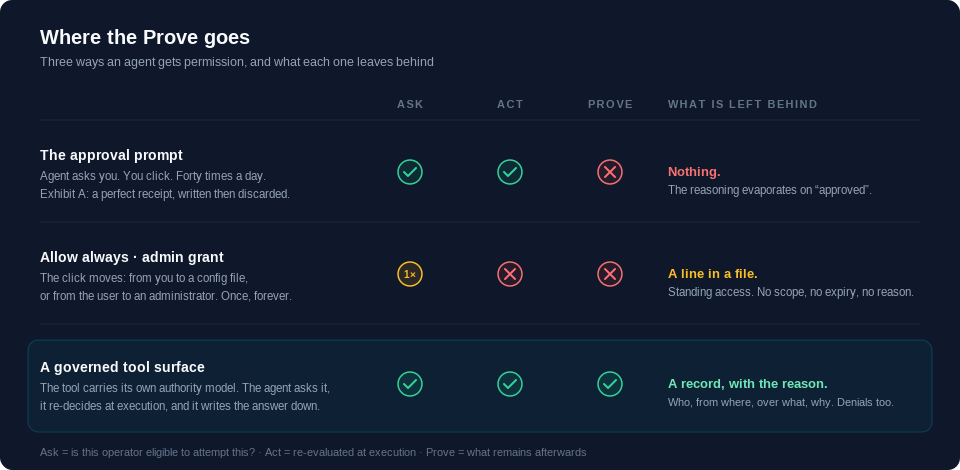
That is the real difference, and it is not fewer clicks. The governed tool surface moves the author of the decision — from a tired human reflex to a computed evaluation against the persona, the position, and the delegated scope — and it keeps what it decides. Who acted, from which position, under whose authority, for which operation, against which target, and why it was allowed, or the specific reason it was not. Denials leave records too. Ask a governed tool for something outside your delegated scope and you do not get a permission prompt; you get a computed no, with the factor that decided it, on the record.
Same silence at the keyboard. Opposite security posture underneath. The agent was never the problem. It reasons about authority forty times a day, and nobody writes it down.
Ask. Act. Prove. was the contract. This is the contract at a developer’s desk.
The invitation
If an MCP server could declare its authority contract — these operations are governed; here is the shape of the receipt — a client would not need to ask a human about tools that already know their own authority. It could verify a receipt instead. That is a protocol posture, not a product feature, and it belongs to the people who own the protocol.
Anthropic, OpenAI: your agents already do the Ask and the Act. We have a reference implementation for the part that goes missing. The prompts are your product being careful. The receipts are what careful looks like when it has somewhere to write things down.
And if the next question is who are you — fair. Five humans and a workforce of trained agents, building an authority platform with the same coding agents this post is about, governed by the thing we built. We did not read about the approval prompt. We live in it.
So, one question for anyone shipping a coding agent. When your agent writes that careful little receipt and I type approved — where does it go?
IdentityRM governs delegated authority at the point of operation — for human operators and AI agents alike — and exposes it through governed MCP tools any MCP-capable client can call. Read the contract, see it stand up an organization in five minutes, or see the platform.
