Authority Governance in Five Minutes
The industry prices a delegation model in consulting quarters. Here is the five-minute version: describe how you operate, watch a live model argue its case, preflight it, apply it, and ask it an authority question — evidence attached.
Everyone assumes standing up an authority model means months of workshops and a hand-written policy schema. It does not. Describe how your organization operates in plain language - the Authority Design Engine matches the closest operating model from a corpus of industry-informed authority patterns, asks only the questions that materially change the design, and assembles a live, explainable model. Preflight it, apply it, then ask it: am I authorized to grant roles at Contoso? Five minutes from operating intent to executable governance.

"The breakthrough is not faster YAML. It is that years of governance knowledge become reusable software. Five minutes is possible because you are selecting and refining encoded governance expertise, not constructing an authorization model from scratch."
— Martin Gee, Founder & CEO, IdentityRM
Every conversation about delegation governance hits the same wall: “That sounds great, but standing it up would take us a year.”
The assumption is earned. Every previous generation of this problem was a project — role workshops, an entitlement spreadsheet, a policy DSL somebody has to learn, a custom admin portal somebody maintains forever. The relationship engines that came later moved the work up a level but kept the homework: you still author the whole model, in a schema, by engineers.
So here is the claim, stated so you can hold us to it: five minutes from operating intent to executable governance. Not five minutes to a prettier diagram — five minutes to a governed organization that answers authority questions about itself, with evidence. This is a five-minute read to match.
Minute one: describe how you operate
You do not start with a schema. You start with a sentence:
“Design an authority model for an MSP that needs strong client isolation and delegated support teams.”
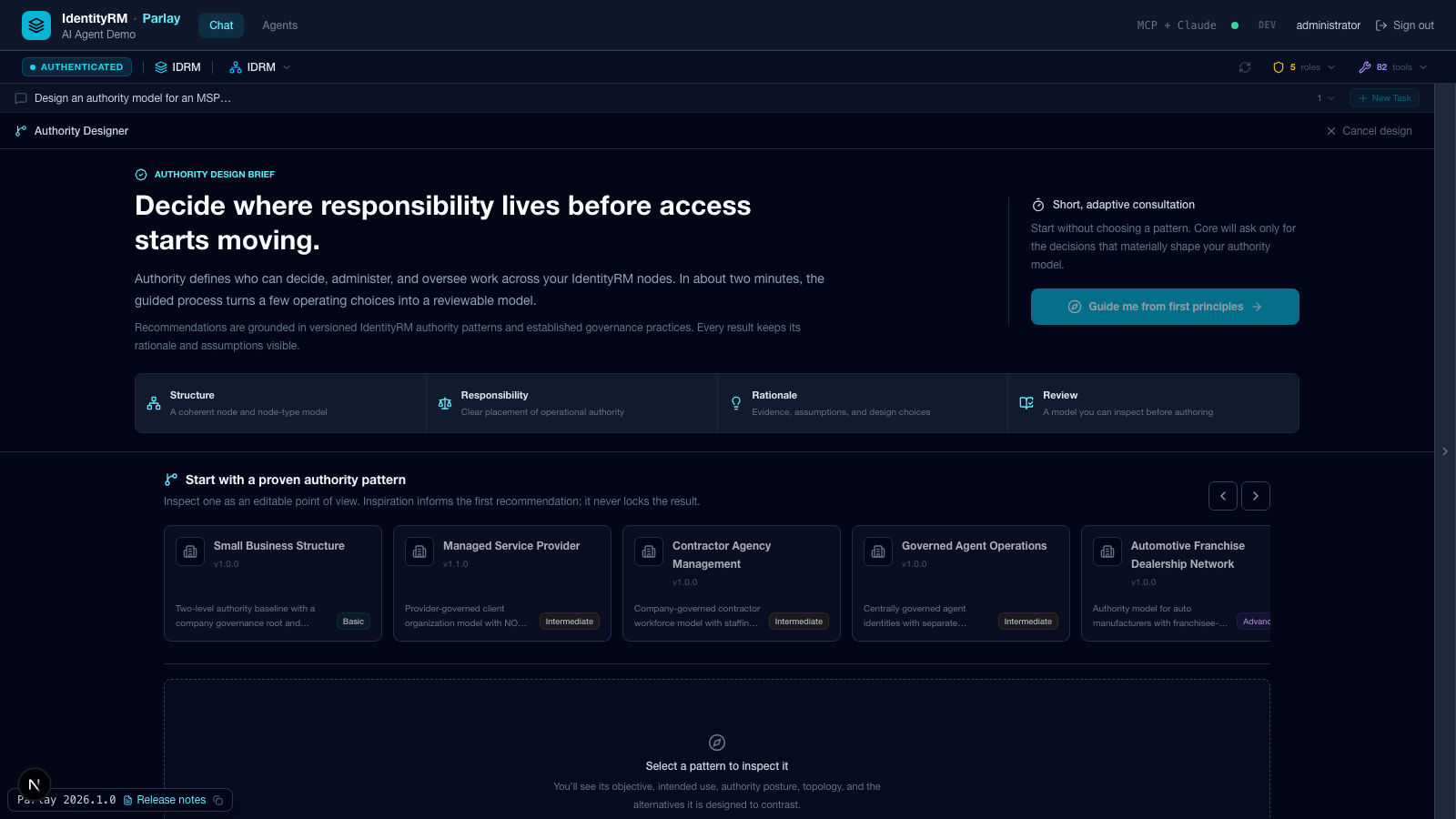
The Authority Designer opens on a contract, not a form: decide where responsibility lives before access starts moving. Shape the structure, place responsibility, review the result — about two minutes, and no changes are made until you review the completed design. Start from first principles, or inspect a proven pattern for inspiration — managed service providers, franchise networks, contractor workforces, governed agent fleets. Inspiration informs the first recommendation; it never locks the result.
The engine does not guess. It asks — seven questions, and only the ones that materially change the design. Four it will not commit without: what kind of business you run, how it fans out, the default model for day-to-day administration, which outside population matters most. Three place responsibility: who creates operating branches, who owns onboarding and offboarding inside them, who assigns routine roles. That is the whole interview. A wizard collects answers and stamps a template; a design engine holds encoded governance expertise and applies it to your operating model — which is why it needs so few.
Minute two: watch the model argue its case
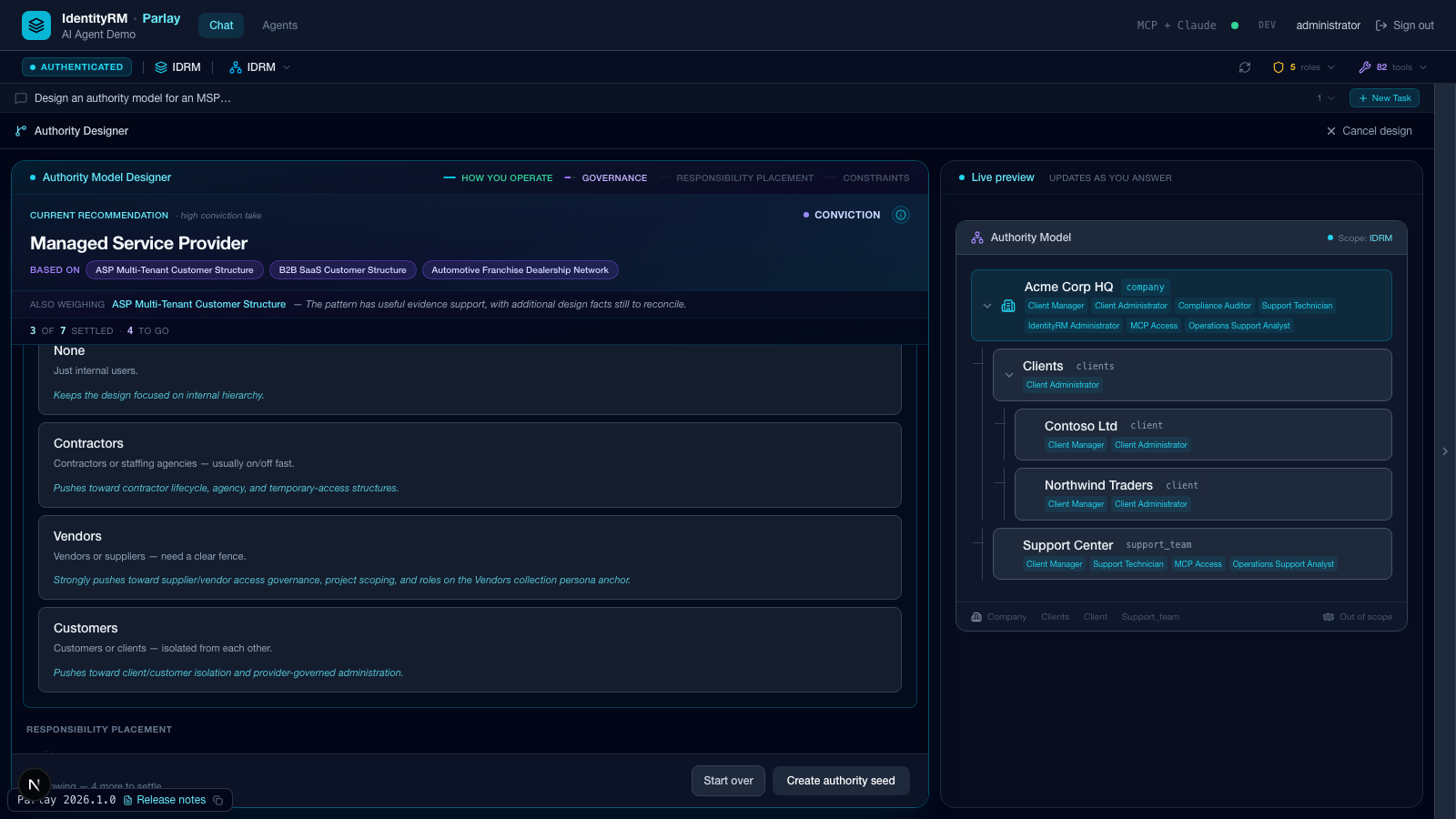
As you answer, the model assembles in front of you. With the answers in, the engine anchored on the Managed Service Provider baseline at supported confidence, citing evidence per answer — “Client isolation describes provider oversight of separate client organization boundaries.” It named the alternatives it was still weighing, ASP Multi-Tenant and B2B SaaS, and the pattern it ruled out and why: Automotive Franchise, conflicted, because hybrid delegation contradicts a recorded fact. On the right, the live preview redraws with every answer: provider headquarters, a customer collection, isolated clients, a shared support center — roles placed where their authority belongs instead of piled onto a global administrator.
When the material questions are settled, the recommendation locks — every answer still one click from Revise — and the footer states the deployment boundary in plain words: creating the seed does not apply it or rebuild anything.
Minute three: it grades its own design
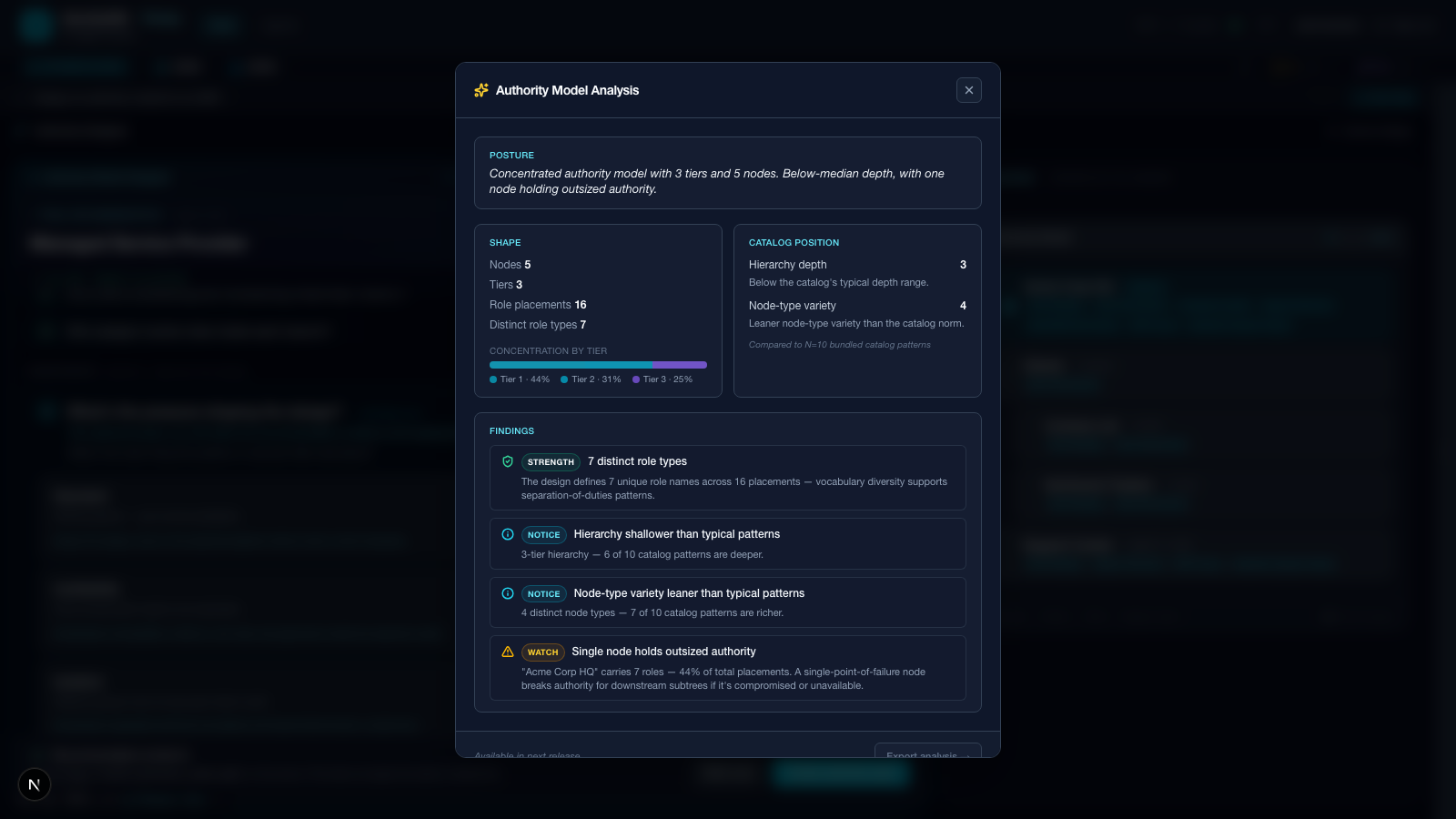
Before you accept it, the Designer analyzes the model it just proposed — depth, node-type variety, role diversity, concentration by tier — and it does not grade on a curve. This run earned a strength (seven distinct role types, a real separation-of-duties foundation) and a watch: one node holds 44 percent of role placements, a single point of failure for everything beneath it. That is the difference between drawing a hierarchy and evaluating an authority design — and the tool says it about its own recommendation.
Minute four: preflight
The design becomes a versioned authority pattern and its seed. It also asks which identity provider the organization runs — Okta, Microsoft Entra, Auth0, or PingOne — and binds the seed to it. The five minutes are the same against any of them. The IdP is the data plane; the authority model is the control plane, and it does not care whose token mint it governs. Before anything applies, preflight checks structure, roles, identity-provider and service configuration — before a single thing changes in your environment. Governance starts before the model exists.
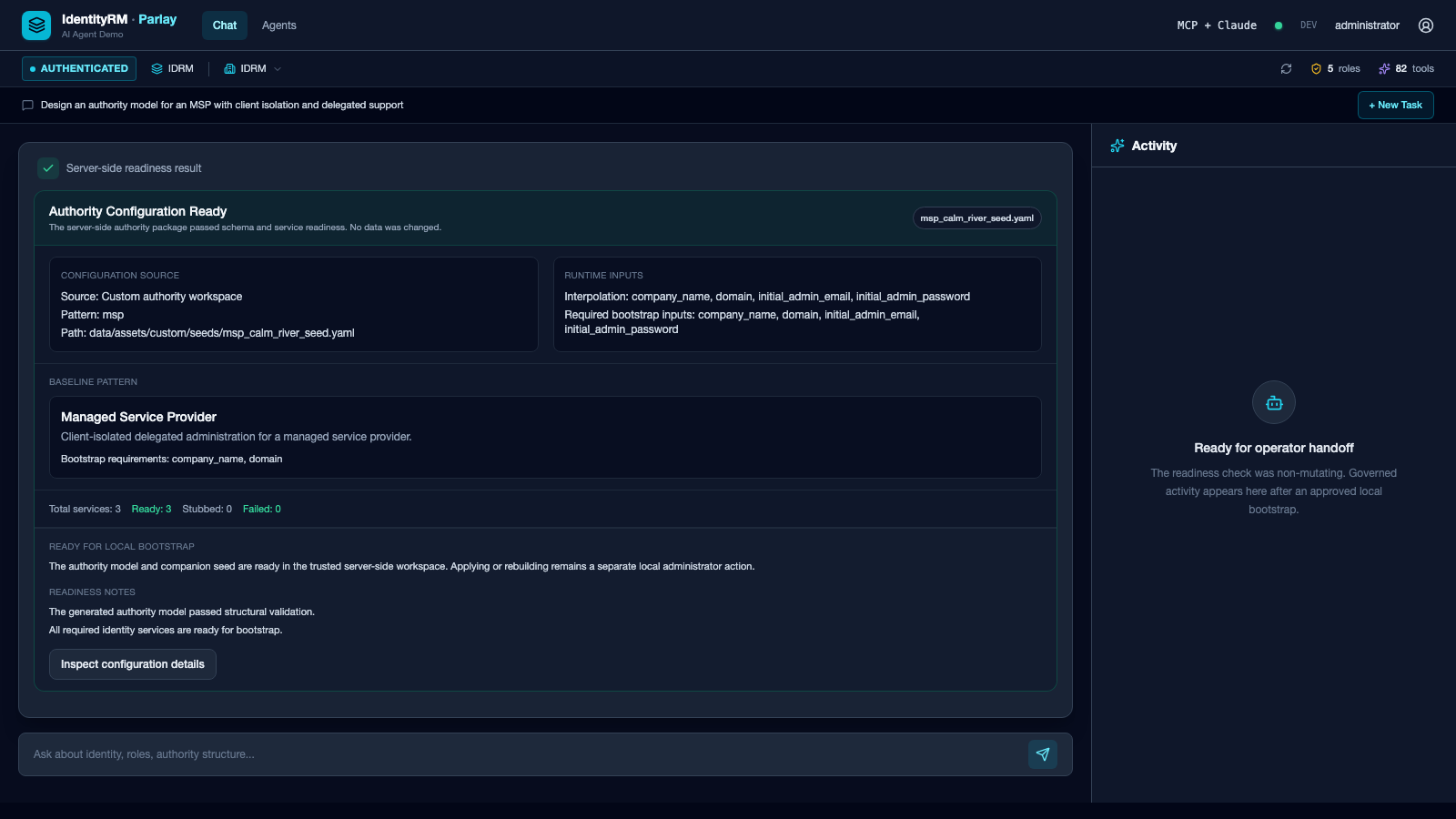
Preflight is not a formality. It validates the seed against the real environment — structure, roles, and the identity-provider services it will bind to. This run passed: the generated model cleared structural validation, all three identity services came back ready, and the panel says the words that matter — no data was changed. Applying is still a separate, deliberate administrator action; the Activity panel reads ready for operator handoff. If anything had been wrong, preflight would have stopped before mutation, named the exact failure, and handed back a correction path. Sensitive configuration is encrypted in the browser before it ever leaves the page. A confident recommendation does not get to bypass deployment safety.
Minute five: apply, take a position, ask
Apply. Then ask the operator’s first question of any new environment — show me the authority model — and what comes back is an organization, not configuration.
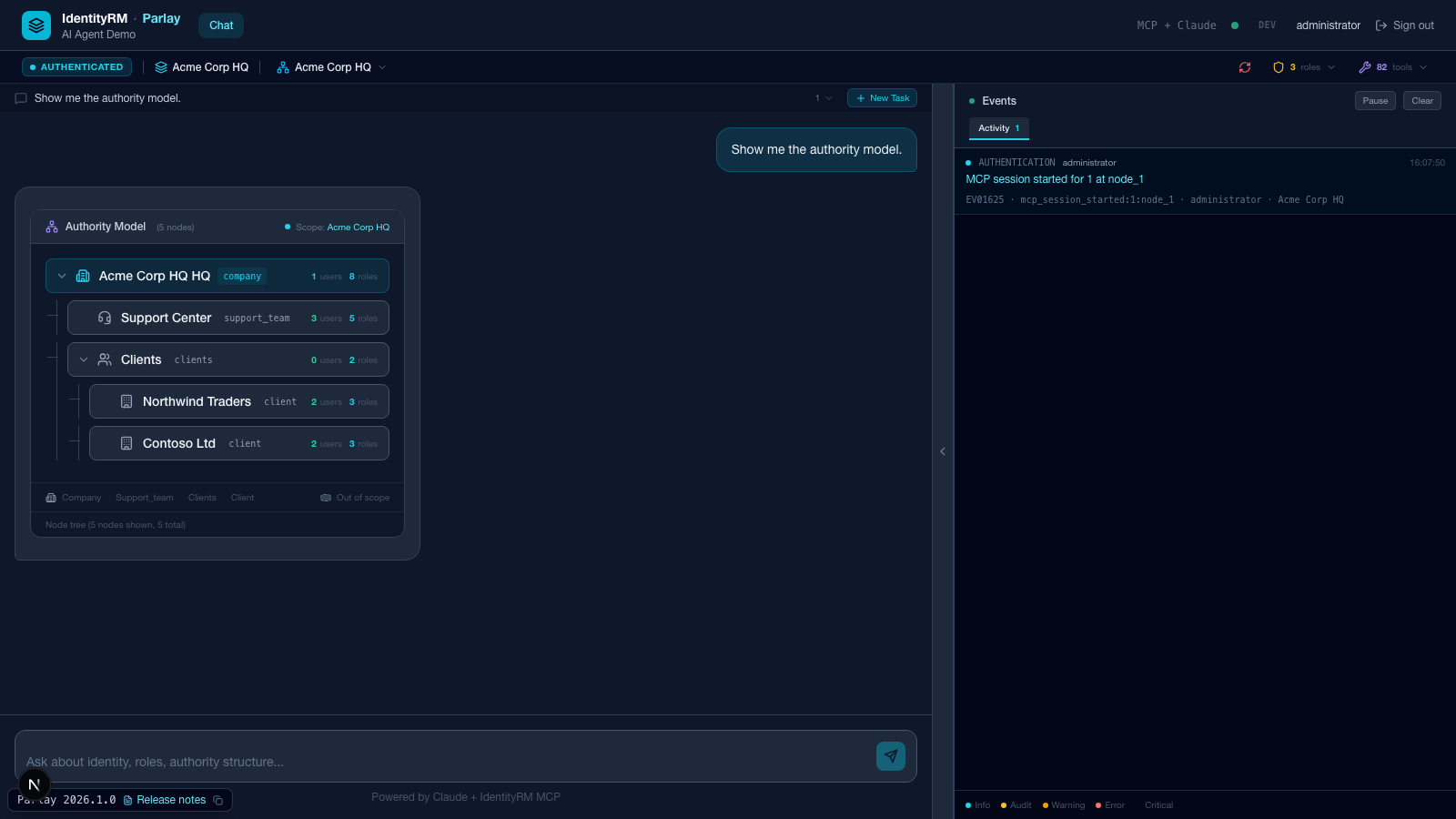
Five nodes. Headquarters with eight roles placed at the top; a Support Center with its own five; a Clients collection; Northwind Traders and Contoso Ltd as isolated client branches, each with its own users and roles and no view of the other. Every role is already scoped to where it belongs. Operators enter by taking a position, a persona at a node: a support technician at the Support Center; a client administrator inside Contoso and nowhere else. Reach is a property of where you stand, not what you carry.
Now ask it a question, in plain language, as an operator or an agent would — this organization’s version of the question the platform is built around:
“Am I authorized to grant roles at Contoso?”
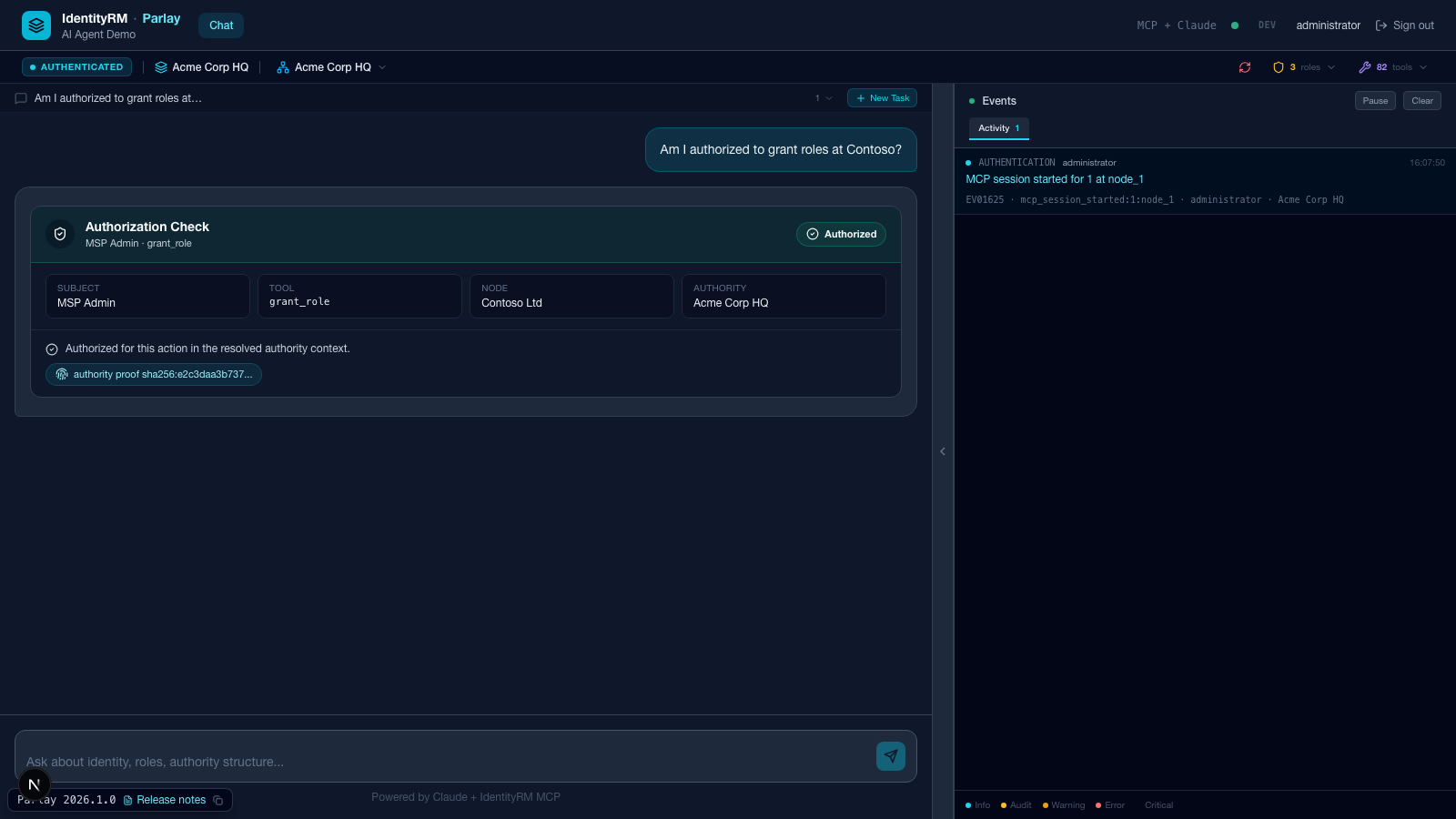
The answer comes back computed — subject, tool, target node, and the authority it was resolved under — with the proof attached: authorized for this action in the resolved authority context, and a hash of the authority context that produced the verdict. Authorized, and here is why. Had the same question come from a client administrator inside Northwind, the answer would be no — and the card would say exactly why. The ask is honest about its boundary: it establishes eligibility, and the act still re-checks everything at execution. You now have something no spreadsheet, portal, or policy engine gives you on day one: an organization that answers authority questions about itself, with receipts.
Five minutes. Timer stops.
What you did not build
No role workshop, no entitlement spreadsheet, no policy DSL, no schema review, no custom portal on the roadmap. When the company reorganizes, scope follows position — nothing hardcoded breaks, because nothing is hardcoded. And the same Designer treats AI agents as what they are — an organizational design problem, not an account type: a governed home, operating personas, explicit roles, human oversight. That is its own pattern, and its own post.
None of this is a demo script. Underneath the five minutes is the delegation architecture granted as US Patent 12,549,558 — N-level scope trees, invisible scope boundaries, node-type templates — and an engine that designs into it. The five minutes are fast because the hard part was built once, and it is the part nobody else has.
The industry prices this problem in consulting quarters because it has only ever seen it as a project. It is a product now. Set a timer.
The pattern corpus, the design engine, the preflight, the question, and the receipts — this is shipping functionality, not a roadmap. See the demos, or read what Authority Governance actually is. Building with agents? Start with how your agent knows what it can do.
